The right 75 gallon aquarium heater keeps your freshwater or saltwater tank within a stable, safe temperature, protecting fish, corals, and other inhabitants. This guide highlights five well-suited heaters for 75-gallon setups, helping you pick the best match for your tank type, maintenance routine, and safety priorities. Ideal buyers include hobbyists upgrading a large freshwater setup, reef hobbyists seeking reliability, and new tank owners needing dependable, auto-protect features.
| Product | Wattage | Ideal For | Key Safety Features |
|---|---|---|---|
| HiTauing 300W/500W Submersible | 300W / 500W | Tall 75-75-gallon setups; both freshwater and saltwater | Over-temperature protection, water-out protection |
| Orlushy 500W Submersible | 500W | 40–75 gallon tanks; versatile for mixed habitats | Explosion-proof quartz glass, automatic shut-off when temp reached |
| HiTauing 300W with LED Display | 300W | Freshwater and marine tanks up to 75 gallons | Intelligent protection, rapid heating, long cord |
| Orlushy Adjustable 500W | 500W | 75 gallon or larger, adaptable to water changes | Durable outer shell, real-time thermometer option |
| HiTauing 300W/500W Intelligent, 94℉ Cutoff | 300W / 500W | Saltwater & freshwater tanks around 75 gallons | Leaving-water auto-stop, safety and temperature control |
HiTauing 300W/500W Submersible Heater: Quick Heating And Safety
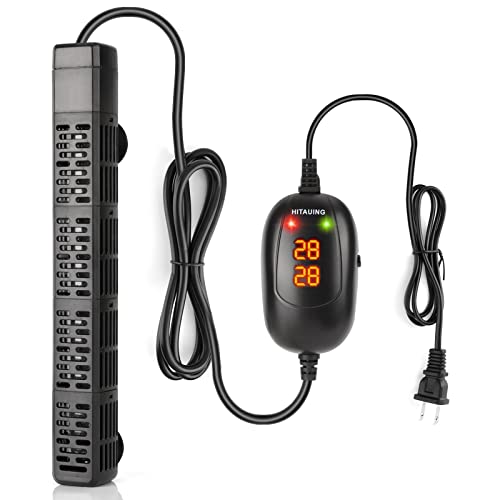
The 300W model is designed for 40–75 gallon tanks, using a nickel-chromium heating wire for rapid, stable warmth. It includes a dual-temperature control system, offering Fahrenheit and Celsius options (63–94℉ / 17–34℃). Best for hobbyists who want fast heat-up and straightforward dial control. A safety advantage is its intelligent water sensing and an automatic shutdown if the heater is out of water or overheats. Consider this unit if you want a reliable option that works well in both freshwater and saltwater environments, with a minimal risk of overheating.
Best for: Intermediate-to-advanced hobbyists who prioritize quick response and solid over-temperature protection.
Caution: If you run a very shallow tank, ensure the heater is fully submerged per instructions to avoid false readings.
Orlushy 500W Submersible Heater: Strong, Versatile For 40–75 Gallons
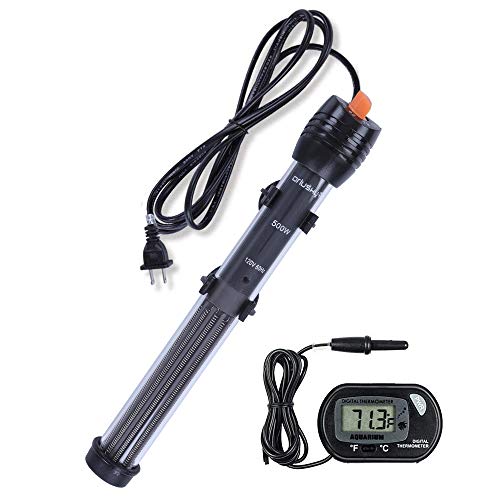
This 500W heater is suitable for the upper end of a 40–75 gallon range. It features explosion-proof quartz glass, a robust 6 ft power cord, and a simple adjustable thermostat. It’s ideal for larger tanks that may require stronger heating to maintain stable temperatures. This option is particularly attractive for mixed habitats where both freshwater and saltwater sections appear in the same system. A limitation to note is that wattage must match tank size; selecting too high a wattage for your actual volume can lead to overshoot risk if not carefully tuned.
Best for: Tank owners who need robust heating for a larger 75-gallon system and value a straightforward analog thermostat.
Caution: Confirm your tank’s temperature stability and consider a controller or external monitor to fine-tune readings over time.
HiTauing 300W With LED Digital Display
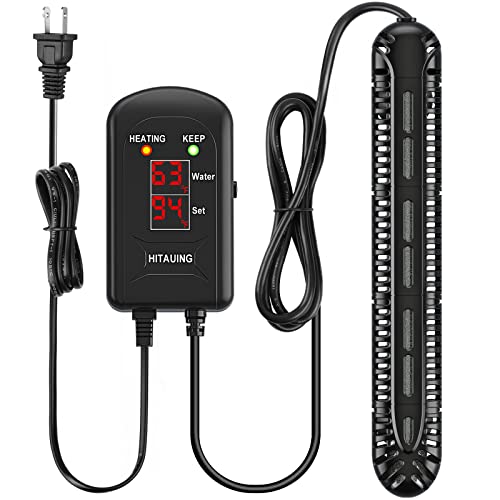
This model uses a digital display for precise temperature control, with a 300W rating suitable for 40–75 gallon tanks. It emphasizes safety through intelligent protection systems: over-temperature stop, and an “out of water” alert. The long power cord and in-tank placement make it convenient for larger configurations. It’s a solid choice when you want easy readability and a compact, integrated design that reduces guessing about current water temperature.
Best for: Beginners and intermediate aquarists who want a clear readout and dependable safety features.
Caution: The 300W rating may be insufficient for heavily stocked or unusually warm environments; consider stepping up to 500W if the tank runs consistently warm or if the aquarium is deeper than typical 24 inches.
Orlushy Adjustable 500W With Real-Time Thermometer
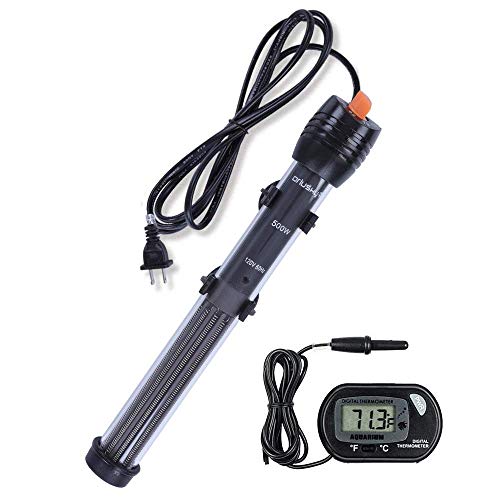
Orlushy’s adjustable 500W heater is designed for 40–75 gallon tanks and includes an external thermometer option for real-time temperature checks. The device uses a nickel-chromium heating wire and a quartz glass tube with a durable outer shell. This setup is well-suited for aquarists who want straightforward adjustability and a visible temperature reference. A potential limitation is that the external thermometer may require regular calibration to ensure consistent readings across changes in environment and water chemistry.
Best for: Those who prefer visible temperature tracking and a sturdy, mid-range wattage heater for a standard 75-gallon system.
Caution: Verify the alignment of the thermometer with your tank water line to avoid drift in readings during routine maintenance.
HiTauing 300W/500W Intelligent Heater With Auto Stop

This HiTauing model emphasizes intelligent leaving-water auto-stop, robust temperature control, and compatibility with saltwater or freshwater setups. The 300W unit is suitable for 40–75 gallons, with a long power cord and a 12.99 inch heater rod. The system is designed to detect when the heater head is out of water and to stop heating accordingly, reducing the risk of damage. A limitation to consider is that the protection features depend on proper submersion and water level stability; users should ensure the heater head remains fully submerged for accurate readings.
Best for: Aquarists who want a heater with advanced safety protections and a longer reach for more flexibility in large tanks.
Caution: In very shallow tanks, verify submersion depth recommendations and avoid edge placement that could cause readings to drift.
Buying Guide: Key Considerations For 75 Gallon Heaters
- Tank volume and wattage: For a 75-gallon tank, 300–500W is typical. If the tank is heavily stocked or in a cooler room, consider higher wattage with a temperature controller.
- Safety protections: Look for automatic shut-off when out of water, over-temperature protection, and accuracy within ±1–2°F to prevent overheating or underheating.
- Submersion and placement: Ensure the heater is fully submerged and positioned away from filter intakes or decorations that could obstruct flow.
- Temperature control: Digital displays or easy-turn dials aid precise settings. Celsius/Fahrenheit compatibility is useful for international setups or hobbyist communities.
- Material durability: Quartz glass with nickel-chromium heating wires offers robustness in saltwater and freshwater environments. A strong ABS housing adds safety against accidental contact.
- Aquarium type considerations: Saltwater tanks may require more stable heat due to photosynthetic needs; freshwater communities vary with bioload.
- Maintenance and monitoring: Consider whether you want an internal heater or one with external sensors. Regular checks help ensure readings align with actual water temperatures.
Frequently Asked Questions
- What wattage should I use for a 75-gallon tank?
Most setups use 300–500W, depending on whether the tank is heavily stocked, shaded by room temperature, or kept in a cooler environment.
- Is it better to choose a digital or analog heater?
Digital displays provide precise temperature readings and easier monitoring, while analog units are straightforward but require manual checks.
- Do I need an external thermometer with an in-tank heater?
A thermometer helps verify that the heater maintains the desired temperature, though many heaters include accurate integration features.
- What safety features are most important?
Auto shut-off when water level drops, over-temperature protection, and dry-run prevention reduce risk to fish and equipment.
- Can I use a single heater for both freshwater and saltwater?
Yes, many heaters are designed for both environments, but verify compatibility with your specific species and tank conditions.
- What maintenance steps keep heaters working long-term?
Regularly inspect for mineral buildup, ensure submersion integrity, and test temperature readings against a reliable thermometer.