Best Circulation Pumps for Aquariums — Top Picks for Fresh and Saltwater Setups
Answering the question, these circulation pumps improve water movement, boost oxygenation, and reduce debris buildup in both freshwater and marine tanks. They’re ideal for hobbyists who want stronger water flow without loud operation. The top picks below cover compact nano pumps for small tanks and larger, high-flow heads for bigger aquariums. Each product is best for a specific tank size, water type, and maintenance preference. See the quick buyer table after this intro for a snapshot of suitability and capacity.
Buyer snapshot table:
| Product | Tank Size (Best For) | Flow (GPH) | Notes |
|---|---|---|---|
| Hydor Koralia Nano | 10–28 gallons fresh, 10–15 gallons salt | 240 | Compact, low power, easy placement |
| DaToo 800GPH Wave Pump | 20–40 gallons | 800 | 360° rotatable, quiet, anti-backflow |
| AQUANEAT 2 Pack 480GPH | 60–75 gallons fresh or 45–60 gallons salt | 480 | Dual-pack, 360° flow control |
| Zhengmy 4 Pcs 800GPH | 20–100 gallons | 800 | Multiple heads, broad coverage |
| Hygger 1050 GPH | 20–60 gallons | 1050 | Ultra-quiet, 360° rotation |
Hydor Koralia Nano Aquarium Circulation Pump

The Hydor Koralia Nano delivers a steady 240 GPH flow in a compact 2.4-inch footprint. It uses a vibration-absorbing magnet and suction cup system to minimize noise and movement. Best for small to mid-sized tanks, this pump suits freshwater tanks around 16–28 gallons and small saltwater setups 10–15 gallons. It consumes about 3.5 watts, offering energy efficiency with a notable water pulse advantage over earlier Koralia models. Choose this if you need a discreet, space-saving circulation option that’s easy to position for targeted flow. Caution: ensure tank glass is not thinner than the manufacturer’s limit to avoid potential wobble or dislodgement.
DaToo 800GPH Mini Aquarium Circulation Pump

The DaToo wave pump provides 800 GPH with a 3W motor and a 360° rotatable head. It’s designed as a “multi-functional water flow manager” suitable for freshwater and saltwater tanks. The unit emphasizes silent operation, anti-backflow mechanics, and a protective filter cover to prevent fish from being drawn in. Best for fish tanks requiring adjustable flow angles and integrated circulation with oxygenation and filtration. Choose this if you want flexible, orientation-friendly flow with minimal noise. Limitation: performance can vary with tank height and surface tension; position for optimal surface agitation.
AQUANEAT 2 Pack Aquarium Circulation Pump — 480 GPH

This compact dual-pack delivers 480 GPH per pump and is ideal for medium-sized tanks (60–75 gallons freshwater or 45–60 gallons saltwater). Each unit features 360° articulating ball joints for full rotational control, enabling movement and oxygenation to reach top and bottom layers. Best for users who want to distribute flow more evenly across a larger habitat. Choose this if you prefer a two-head setup to cover multiple tank zones. Caution: ensure your power strip and cords are dry and away from splashes to prevent water contact.
Zhengmy 4 Pcs 800 GPH Aquarium Circulation Pump

The Zhengmy set includes four 800 GPH powerheads designed to simulate natural currents in 20–100 gallon tanks. Submersible and compatible with freshwater and saltwater systems, these pumps help move detritus toward filtration and reduce stagnant zones. Best for larger tanks or hobbyists who want broad coverage with multiple heads. The package is beneficial for shared aquariums or multi-zone layouts. Limitation: with four heads, management may be more complex; ensure adequate space and safe placement to avoid tangling or crowding around denser decor.
AQUANEAT Circulation Pump — 800GPH

The AQUANEAT 800GPH powerhead focuses on large-tank circulation and 360° rotation for full-zone movement. Recommended for tanks in the 75–120 gallon range, it supports strong water flow to keep surface water oxygenated and debris suspended for filtration. Best if you need robust circulation without multiple units. Avoid this if you operate a small tank, as the high flow can create excessive surface agitation or stress delicate organisms in compact spaces.
Hygger 1050 GPH Aquarium Wave Maker
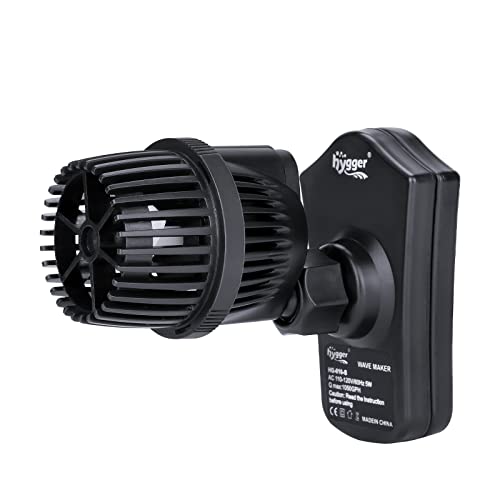
The Hygger 1050 GPH model emphasizes a strong, quiet flow with a 360° rotating head. It’s designed for tanks around 20–60 gallons and features a magnetic base for stable mounting. Best for aquariums needing a pronounced current without large equipment footprint. Choose this if you want high throughput with minimal noise and simple installation. Limitation: very high flow may be excessive for nano or coral tanks; adjust position and flow to avoid creating too much disturbance.
Buying Guide
What size is your tank, and what water type do you keep? Match the pump’s flow rate to the tank volume and desired turnover per hour. For small tanks (10–30 gallons), compact nano pumps offer targeted flow with minimal space needs. For larger or coral tanks, higher-flow models or multi-head configurations provide better circulation and oxygenation. Consider noise level, energy use, and ease of cleaning when selecting a unit. Look for adjustable heads and 360° rotation to maximize coverage and prevent dead zones. If you keep sensitive species, start with moderate flow and increase gradually.
How many heads do you need? A single head can handle smaller tanks or specific zones, while multiple heads offer broader coverage in larger tanks. Ensure that the mounting method and suction cups are compatible with your tank material and glass thickness. For saltwater setups, ensure components are corrosion-resistant and suitable for marine use. Finally, verify that the device remains submersible and waterproof to protect electronics during water changes and cleaning.
FAQ
- What is a good turnover rate for most reef tanks? A typical turnover is 10–20 times the tank volume per hour, but reef tanks often benefit from variable flow depending on coral and livestock needs.
- Can I run multiple pumps in one aquarium? Yes, but plan flow directions to avoid creating chaotic currents and to ensure even distribution of oxygen and debris removal.
- What should I do if a pump is noisy? Check mounting stability, clean impellers, and verify that the head is not bent or rubbing against the tank wall.
- Are these pumps suitable for freshwater and saltwater? All listed models claim compatibility with both freshwater and saltwater, but verify materials and seals for marine use.
- How do I choose between single high-flow vs. multiple lower-flow heads? For larger tanks, multiple heads provide uniform coverage and easier customization of flow zones; for small tanks, a single efficient unit is often sufficient.