Answering your CO2 monitoring needs, these CO2 drop checkers help you keep planted tanks thriving with precise visual indicators. This guide targets aquarium owners seeking reliable, easy-to-read CO2 monitoring tools for planted tanks, from beginners to hobbyists with larger setups. Below you’ll find five well-matched options, each with a quick why-it’s-right-for-you and a sensible limitation to consider. A concise buyer’s table follows the intro to help compare at-a-glance.
| Product | Best For | Indicator Type | Notes |
|---|---|---|---|
| Clscea CO2 Indicator Solution Drop Checker (60ml) | Longer storage needs | Liquid indicator | Two 30 ml bottles |
| Pawfly Glass CO2 Drop Checker Kit | All-in-one starter kits | Liquid indicator | Includes tubing and suction cups |
| JARDLI Glass CO2 Drop Checker | Reliable, simple setup | Liquid indicator | Pre-made solution |
| NilocG Aquatics 4dKH Drop Checker Solution | Precise chemistry control | 4dKH solution | Pre-mixed guarantee |
| FZONE CO2 Glass Drop Checker Kit | Fast readings | 4dKH solution | Color-coded indicators |
Clscea CO2 Indicator Solution Drop Checker Kit (60ml)

This drop checker includes two 30 ml indicator solutions, offering extended storage and reliable readings for mid- to large-sized planted tanks. The kit is designed to monitor CO2 levels essential for plant health and fish safety. Best for aquarium owners who value stable reagent supply and straightforward usage.
Best for: hobbyists who prefer bulk storage and a simple setup without extra accessories beyond the drops. Limitation: relies on the supplied indicator solution; replace as needed to maintain accuracy.
Pawfly Glass CO2 Drop Checker Kit with Solution & Suction Cups

This complete CO2 monitor kit includes curved glass tubing, a reagent bottle, and two suction cups for easy placement. It’s easy to use: add 20 drops to the tubing, install vertically on the tank wall, and read the color change after about two hours. Best for: beginners and hobbyists who want an all-in-one, ready-to-use solution. Limitation: tubing must be oriented with the opening facing down for accurate results.
JARDLI Glass CO2 Drop Checker with Solution
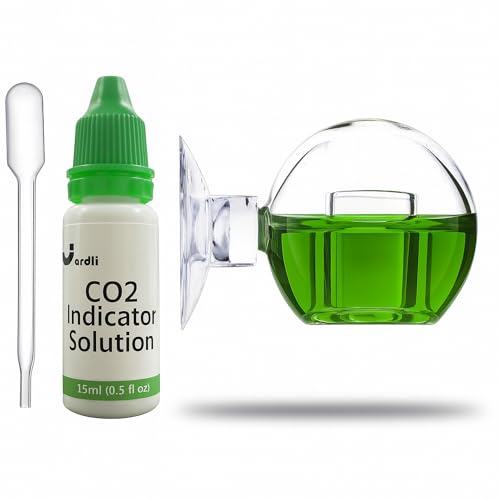
JARDLI’s drop checker uses a pre-made 4dKH solution, eliminating the need for user mixing. Place it in the tank with a suction cup, and interpret color changes: green means CO2 is balanced, blue or yellow indicates too low or too high CO2. Best for: users who want predictable, low-effort setup. Limitation: still requires proper placement and a readable color interpretation over time.
NilocG Aquatics Co2 Drop Checker Solution (4dKH)

NilocG Aquatics provides a 4dKH fluid with built-in PH reagent, streamlining accuracy. The flip-top bottle design supports easy use. Best for: experienced hobbyists who rely on consistent chemistry and want reduced setup steps. Limitation: requires adherence to the 4dKH fluid instruction for accuracy; using other fluids may reduce reliability.
FZONE Aquatic CO2 Glass Drop Checker Kit

FZONE’s kit emphasizes a quick setup with the most accurate 4dKH solution and color-coded results. Expect a simple readout: blue for low CO2, green for balanced, and yellow for too much CO2. Best for: tank owners who want clear, rapid feedback. Limitation: reading accuracy depends on proper container filling and time to stabilize.
Ultum Nature Systems CO2 Drop Checker

Note: This section is provided for context. The five selected options above focus on a balance of price, availability, and ease of use for most planted tanks. If you have a preference for a full kit or a certain chemistry standard, consider a model that aligns with your routine.
Buying Guide
What to consider when choosing a CO2 drop checker solution?
CO2 stability and tank size: Larger tanks may benefit from kits with multiple indicators or bulk reagent storage. If you have a nano tank, a compact, ready-to-use checker reduces setup friction.
Indicator chemistry: 4dKH-based solutions are common. Ensure the kit clearly states the liquid’s buffering level to prevent reading drift. Pre-mixed solutions reduce user error.
Ease of use: Look for clear instructions, a stable suction cup, and a readable color scale. Some kits include extra accessories like tubing, straws, and multiple suction cups for flexible placement.
Readiness and maintenance: Check how long the indicator lasts and whether the bottle design supports easy refills. Some brands emphasize long-lasting indicator solutions for better storage and fewer replacements.
Accuracy vs. convenience: Pre-made solutions offer convenience but may limit customization. If you prefer precise control of pH-related parameters, choose a kit with clearly labeled 4dKH fluid and a reliable color reference.
FAQ
How do CO2 drop checkers indicate tank CO2 levels?
They use color-changing indicator solutions that respond to CO2 concentration in the water. Common readings are green for balanced, blue or yellow for low or high CO2, respectively.
What size tank is best for a drop checker kit?
Drop checkers work across most freshwater planted tanks, from nano to large setups. The choice often depends on tube length, placement options, and whether you need additional accessories like tubing or suction cups.
Should I use a pre-mixed 4dKH solution?
Pre-mixed 4dKH solutions reduce user error and simplify readings. They are widely recommended for consistent accuracy, especially for beginners.
How long should I wait after placing the checker in the tank?
Most kits advise waiting about 1–2 hours for stable readings, though some indicate readouts after around 1 hour. Always follow the specific kit’s timing guidelines.
Can I reuse the same drop checker with different solutions?
Reusing with different solutions can lead to inconsistent results if the new solution interacts differently with the indicator. It’s best to use fresh indicator fluid per kit instructions.