Best LED Light for 55 Gallon Aquarium: Full-Spectrum Options for Plants and Fish
Answering the need for brilliant, plant-friendly illumination in a 55-gallon setup, these LED aquarium lights are aimed at reef-style color renderings, plant growth, and reliable day-night simulation. This guide highlights five top options, explaining who each light is best for, and why they stand out. It’s ideal for freshwater tanks with mid-to-high light requirements and aquarists seeking adjustable timing, color control, and easy installation.
Summary table of selected products
| Product | Best For | Key Benefit | Limitations |
|---|---|---|---|
| AQUANEAT LED Aquarium Light (48-54 inch) | Mid-to-large tanks needing full cover lighting | Wide spectrum with multiple color LEDs | May require mounting alignment for 48-54 inch reach |
| AQQA LED Aquarium Light (48-55 inch range) | DIY enthusiasts and 24/7 cycle fans | DIY modes, memory function, IP68 | More complex controls for first-time users |
| SEAOURA 48-54 inch Full Spectrum | Beginner to intermediate plant keepers | Simple controls, strong full spectrum | Limited advanced preset options |
| IRQWY LED Light (48-54 inch) | Customizable color modes for a natural look | Rich RGB mix for color accuracy | Could be more manual adjustment |
| hygger 42W Advanced 48-54 inch | Planted tanks with DIY color play | Multiple color options with 24/7 mode | Smaller power/brightness range than some larger units |
AQUANEAT LED Aquarium Light Full Spectrum for 48 Inch to 54 Inch Tank
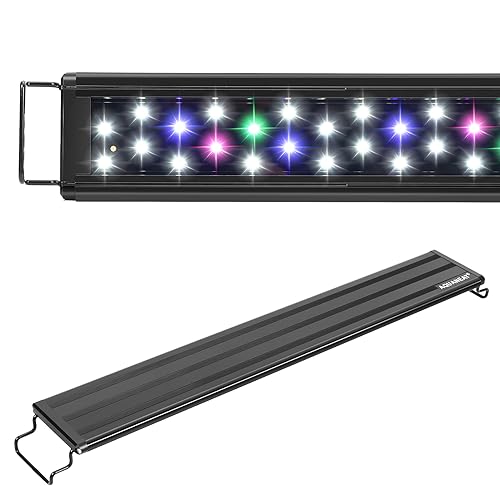
The AQUANEAT model is designed to fit 48 to 54 inch tanks with a 96-LED array, including 68 white LEDs, plus blue, pink, and green accents. It provides a full cover effect for mid-sized 55-gallon layouts and avoids docking brackets by using extendable mounting. This option is best for aquarists who want strong white illumination with color accents to support basic plant growth and showcase fish colors. A limitation is alignment and fit consistency across tank rims, which can affect light distribution in longer tanks.
AQQA LED Aquarium Light with 24/7 Mode and DIY Spectrum

This AQQA model targets enthusiasts who value 24/7 default patterns and DIY customization. It supports a full spectrum with 9 color options, 10 brightness levels, and multiple timer settings, making it suitable for both plant growth and day-night transitions. It’s well-suited for users who want precise control and programmable cycles. Potential drawbacks include a learning curve to maximize the 24/7 features and color cycles for beginners.
SEAOURA Full Spectrum Light for 48-54 Inch Tanks

SEAOURA’s unit emphasizes a straightforward, full-spectrum approach with simple DIY-mode timing and brightness controls. It’s best for hobbyists who want reliable plant growth support without پیچ complicated routines. The 6500K white output, along with red, green, pink, and blue channels, creates a natural appearance for most freshwater setups. A limitation is that advanced automation options may be less extensive than some competitors.
IRQWY LED Aquarium Light for 55/75 Gallon Tanks

IRQWY focuses on 60-piece white LEDs with multiple color modes including blue, red, green, and others. It’s a strong pick for aquariums that require customized color profiles to enhance plant growth and fish coloration. Best for users who want rich color options while maintaining a straightforward control scheme. A potential caution is the reliance on manual color mode switching, which may interrupt flow for some hobbyists when adjusting settings frequently.
AQQA LED Aquarium Light 48-55 Inch with 24/7 and DIY
The 48-55 inch variant mirrors the earlier AQQA model with an emphasis on 24/7 cycling and DIY spectrum. It’s well-suited for larger planted tanks requiring stable daylight patterns and long-running color cycles. Choose this if you value consistent, automated day-night transitions and customizable timer settings. A caution is that the control system may be more complex for beginners than simpler plug-and-play options.
Buying Guide: Key Considerations for 55 Gallon Aquarium Lighting
- Tank coverage: Check length compatibility (48-54 inches is typical for 55-gallon setups) and mounting options to ensure full tank illumination without shadows.
- Color spectrum: Look for a mix of white 6500K for growth, plus blue, red, pink, and green channels to bring out plant and fish color without oversaturation.
- Automation and timers: Decide between 24/7 default modes and programmable timers (6, 8, 12 hours) to mimic natural sunrise and sunset cycles.
- Heat dissipation: Aluminum housing and adequate heatsinks improve longevity and light stability in warm environments.
- Ease of use: DIY modes and LCD controllers are valuable for advanced hobbyists, while simpler presets suit beginners.
- Maintenance compatibility: Consider bracket extendability and whether mounting requires additional accessories to fit your stand and canopy.
- Color rendering index (CRI): A higher CRI (roughly 80-90) helps reveal natural fish and plant colors under LED lighting.
FAQ
- What is the best color spectrum for a 55-gallon freshwater aquarium?
– A balanced full-spectrum mix (white, blue, red, green, pink) supports both plant growth and natural fish coloration. - Do 24/7 aquarium lights benefit plant growth?
– Yes, 24/7 mode simulates continuous daylight, but most setups use a day-night cycle to prevent algae and stress; many models offer adjustable timing. - How important is the light’s length compatibility for a 55-gallon tank?
– Very important. Look for lights that cover 48-54 inches to ensure even distribution across the full tank length. - Are extendable brackets essential?
– They help fit tanks with varied rim sizes and maintain proper light positioning; not strictly essential if your fixture already matches your tank. - What should I consider about power and heat?
– Choose LED options with good heat dissipation to reduce temperature rise in warmer rooms or densely stocked aquariums. - Can I use any LED light for a planted tank?
– Planted tanks benefit from full-spectrum LEDs with enough blue and red spectrum to support photosynthesis; avoid ultra-narrow spectrum lights that lack growth wavelengths.