Best Portable Fish Tank Filter Solutions for Small Aquariums
Finding the right portable fish tank filter depends on tank size, desired filtration type, and whether you prioritize quiet operation or flexible placement. This guide highlights five compact options well-suited for small setups, including 5–10 gallon tanks and portable needs. Each choice is described with who it’s best for, its filtration strengths, and a practical limitation to consider. Use the quick comparison table below to spot key differences at a glance.
| Product | Best For | Filtration Type | Notes |
|---|---|---|---|
| Nano tanks needing robust biological filtration | Biological + Chemical filtration | Includes carbon and foam; great oxygen flow | |
| Very quiet, small tanks | Biochemical filtration + water flow | Ultra-quiet motor; strong filtration | |
| Outdoor use, power outages, transport | Aeration (not a filter) | Battery powered; portable backup | |
| Small tanks needing simple internal filtration | Mechanical + biological filtration | Compact sponge filter; air pump not included | |
| Very small tanks where visibility matters | Mechanical + biological filtration | Slim, quiet, auto restart |
NICREW Aquarium Internal Filter, 5–10 Gallon

The NICREW internal filter uses a combination of activated carbon and fine filter foam to trap debris and fish waste while absorbing odors. It also generates abundant air bubbles, aiding water circulation and oxygenation in 5–10 gallon tanks. This makes it a solid fit for small community tanks or fry setups where stable water quality is key. Best for aquariums that need both mechanical and chemical filtration without taking up wall space.
Best for: hobbyists who want reliable biological and chemical filtration in compact tanks. Limitations: may require occasional media replacement to maintain flow if the filter becomes clogged.
DaToo Aquarium Filter 1–10 Gallons, Ultra Silent
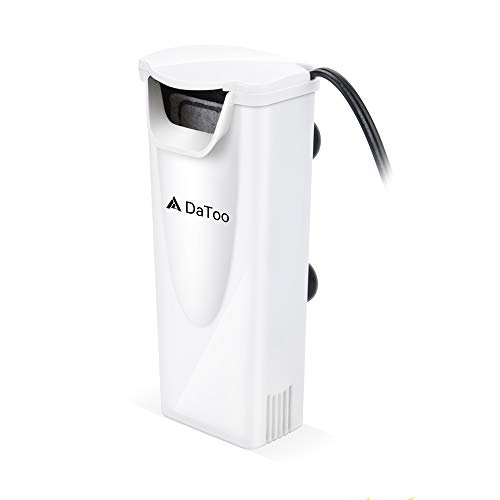
The DaToo filter emphasizes ultra-quiet operation with strong filtration capacity and a waterfall-style flow, helping maintain a clean water column with minimal noise. It’s designed for small tanks and can support additional media like ceramic rings or carbon as needed. Choose this if you value a quiet environment for peaceful tank viewing and night-time operation in a 1–10 gallon setup.
Best for: quiet narration-friendly tanks where noise is a concern. Limitation: reported filtration capacity gains depend on media chosen and tank bioload, so plan for media customization if needed.
Pawfly Battery Air Pump (Portable Aeration)

This portable aeration solution provides essential oxygenation for tanks from 5 to 30 gallons when power is unavailable. It includes a small air stone and tubing within the unit, and runs on two D batteries. It’s not a filter but serves as a crucial backup or outdoor-use option for maintaining oxygen levels during transport or outages. Best for: tanks lacking constant power access or for mobile setups where electrical outlets are scarce.
Best for: back-up oxygen supplementation and field transport. Limitation: not a substitute for a filtration system; it does not remove dissolved wastes or debris by itself.
Pawfly Mini Aquarium Sponge Filter (Up to 5 gal)

The Pawfly sponge filter provides simple internal filtration by trapping debris mechanically while enabling beneficial bacterial colonization for biofiltration. Its compact footprint fits tanks up to 5 gallons, making it suitable for shrimp, Betta, or fry setups where saving space matters. Best for: beginners or nano tanks needing straightforward, low-maintenance filtration. Limitation: water flow is modest, so heavy feeding or high bioload may require supplemental filtration.
NICREW Slim Aquarium Filter for Up to 5 Gallons

The NICREW Slim filter is a compact HOB (hang-on-back) style unit designed for nano and pico tanks. It operates quietly and offers adjustable flow, making it ideal for shrimp or Betta setups where minimal tank disruption is desired. The built-in priming system supports auto restart after power outages. Best for: ultra-compact tanks seeking low-profile filtration. Limitation: flow control is important to prevent excessive current in very small tanks.
Buying Guide: How to Choose the Right Portable Filter for Your Tank
What filtration needs should I prioritize for a portable setup? For small tanks, prioritize models that offer robust biological filtration alongside mechanical media. Activated carbon helps odor control, while filter foam traps debris. If space is at a premium, choose slim or internal submersible designs that won’t loom over the tank lip.
Should I pick a filter with adjustable flow? Yes, especially for nano tanks or shrimp and Betta habitats. Adjustable flow lets you tailor current to the inhabitants, preventing stress or injury while maintaining adequate oxygenation.
Is quiet operation important? For most home aquariums, yes. Ultra-quiet motors reduce stress for fish and improve the viewing experience. When camping or moving tanks, quieter units are easier to manage in shared spaces.
When is media customization valuable? If you have higher bioload, adding ceramic media, bio-balls, or activated carbon can boost filtration effectiveness. Some models explicitly support media customization, which can significantly improve water quality over time.
What about portable aeration? Battery-powered air pumps are excellent backups or outdoor aids. They do not replace filtration but keep oxygen levels sufficient during outages or during transport. Pair them with a sponge or small filter for a more complete solution.
Quick buyer tips
- Match filter size to tank capacity (5–10 gallons for these options).
- Prefer models with auto restart or priming features for reliability.
- Consider media compatibility to optimize odor removal and debris trapping.
- Factor in noise level if you value a quiet living space or office setup.
FAQ
Q: Can a small filter handle a heavily stocked 5–10 gallon tank? A: It depends on bioload. Small filters work best with light to moderate stocking; for heavier bioload, consider multi-media filters or upgrading to a slightly larger capacity unit.
Q: Are internal submersible filters better than hang-on-back for nano tanks? A: Internal submersible models save space and provide stable flow within the tank. Hang-on-back units can be easier to install in certain layouts but may protrude from the tank edge.
Q: Do these filters require frequent media changes? A: Media life depends on tank conditions. Carbon media typically needs replacement to maintain odor control, while foam and bio-media can last longer with proper cleaning and maintenance.
Q: Is it necessary to have both a filter and an aerator? A: Not always. A filter provides mechanical and biological filtration, while an aerator adds oxygen. In well-filtered tanks with good surface agitation, an aerator is optional unless oxygen becomes limiting.
Q: What is the advantage of slim designs for 5-gallon tanks? A: Slim designs minimize visual disruption and fit tightly against walls or in tight spaces, preserving tank aesthetics without sacrificing filtration capability.
Buying tip: If you’re unsure which model best suits your setup, start with a compact internal or slim filter designed for 5–6 gallon tanks. It provides a balance of filtration performance, noise, and size, and you can upgrade later if your tank bioload increases.