Answering the search intent for undergravel filters, this guide highlights five practical options designed for a range of tank sizes. Each choice emphasizes biological, chemical, and physical filtration while delivering reliable aeration. Ideal buyers include hobbyists upgrading older tanks, newcomers setting up small to mid-size aquariums, and anyone seeking a compact, air-driven filtration solution that keeps the tank tidy.
Summary of featured products
| Product | ||
|---|---|---|
| Penn-Plax Undergravel Aquarium Filter for 20–29 Gallon Tanks | 20 Long to 29 Gallons | Balanced filtration with carbon cartridges; aerates water via air stones |
| Penn-Plax Undergravel Aquarium Filter for 10 Gallon Tanks | 10 Gallons | Compact option with easy maintenance; good for small setups |
| Sieral Undergravel Filter for 40–55 Gallon Tanks | 40–55 Gallons | Large plate system with flexible height and comprehensive kit |
| BaoZqua Undergravel Filter System for 20 Gallon Tank | 20 Gallons | Complete kit with extended components for DIY installation |
| Penn-Plax Undergravel Aquarium Filter for 15–20 Gallon Tanks | 15–20 Gallons | Classic air-driven design with simple upkeep |
Penn-Plax Undergravel Filter For 20–29 Gallon Tanks

Best for mid-size community tanks, this air-driven undergravel system relies on an external air pump (not included) to circulate water and oxygen. The setup supports biological, chemical, and physical filtration as water moves through gravel and filter plates, with activated carbon cartridges aiding odor and discoloration control. The design emphasizes a simple, low-maintenance footprint suitable for freshwater and saltwater tanks.
Who it is best for: hobbyists seeking a reliable, straightforward undergravel filter for 20–29 gallon tanks, prioritizing easy maintenance and year-round water clarity.
Limitations: Requires an external air pump not included; effectiveness depends on reliable aeration to drive filtration.
Penn-Plax Undergravel Filter For 10 Gallon Tanks

Designed for compact setups, this 10-gallon option mirrors the classic air-driven filtration approach. It uses lift tubes and activated carbon cartridges to deliver a combination of filtration and aeration with a streamlined interior. It’s a solid pick for small tanks where space and simplicity matter.
Best for: beginners or minimal-space aquariums that still require robust filtration without complex equipment.
Limitation: Smaller tanks may require careful stocking to ensure adequate flow and avoid overloading the bed.
Sieral Undergravel Filter For 40–55 Gallon Tanks

Best for larger aquariums, Sieral provides a comprehensive kit with 16 filter plates, four lift tubes, and four air tubes. The adjustable height and larger plate area support thorough substrate filtration, enabling strong microbial filtration and steady water movement. The package also includes a customizable activated carbon filter sponge for chemical filtration benefits.
Who it’s best for: hobbyists running 40–55 gallon setups that require a scalable, modular undergravel system for robust filtration.
Limitation: The system is more involved to install and adjust, and requires careful planning for tank height and layout.
BaoZqua Undergravel Filter System For 20 Gallon Tank
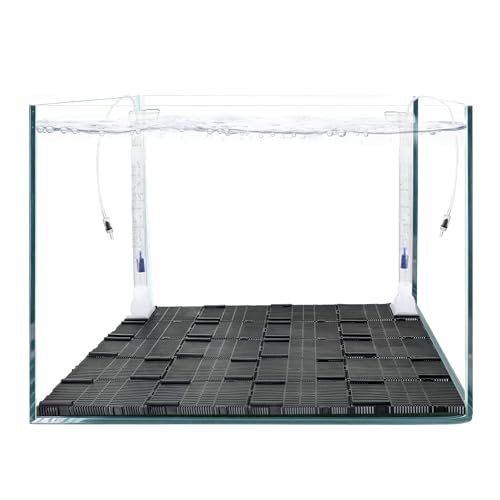
This complete kit includes 20 interlocking plates with two adjustable lift tubes and other essential connections. Air-driven filtration pulls water through the substrate, aiding debris removal and maintaining clear water. It supports a balanced biofiltration cycle and enhanced aeration in a 20-gallon tank.
Best for: aquarists who want a full DIY-ready system with many components for a 20-gallon tank, enabling precise filtration customization.
Limitation: Air pump and tank not included; assembly requires planning for proper airflow and placement.
Penn-Plax Undergravel Filter For 15–20 Gallon Tanks

For mid-range tanks, this Penn-Plax model mirrors the classic undergravel, air-driven filtration with lift tubes and activated carbon cartridges. Its design supports “old school” filtration while maintaining a neat interior appearance. Aeration complements filtration to support fish health and water clarity.
Who it’s best for: aquarists managing 15–20 gallon tanks who want a dependable, uncomplicated undergravel filter with familiar setup and maintenance patterns.
Limitation: Like other air-driven options, performance hinges on a reliable air pump; ensure compatibility with existing equipment.
Buying Guide: Key Considerations For Undergravel Filters
- Tank compatibility: Match the filter plates and lift tubes to current tank dimensions for optimal water flow and filtration efficiency.
- Filtration type: Undergravel systems provide biological, chemical, and physical filtration via gravel-bed filtration and carbon cartridges. Consider whether you need additional chemical media or a larger substrate area.
- Aeration needs: Air-driven filters rely on external air pumps. Plan for pump capacity, tubing length, and noise level in the cabinet or stand.
- Maintenance cadence: Replacement media and carbon cartridges require regular changes. Check recommended replacement intervals for each unit.
- DIY vs. plug-and-play: Some kits offer extensive components for customization, while others favor a ready-to-install approach. Choose based on your DIY comfort and tank setup.
- Size and future-proofing: For growing tanks, consider modular or adjustable systems that can scale with future upgrades without a full replacement.
Frequently Asked Questions
- What is an undergravel filter and how does it work?
It uses the gravel bed as a biological filtration medium while water is drawn through the bed by lift tubes and air-driven flow, facilitating aerobic bacteria growth and filtration.
- Do I need an air pump with these filters?
Yes. All listed filters use air-driven circulation, which requires an external air pump (not included) to drive flow through the system.
- Are undergravel filters suitable for saltwater tanks?
Yes, many models are marketed as safe for freshwater and saltwater; verify saltwater suitability in product specifics before use.
- How often should I replace the filter media?
Replacement intervals vary by model; many recommend monthly to every few weeks for carbon cartridges or media cartridges.
- Can undergravel filters handle heavily stocked tanks?
They are effective for moderate bioloads; heavily stocked systems may require more advanced filtration or supplemental canister filters.