Answering the buyer’s intent: these UV sterilizers are designed to reduce free-floating algae and microorganisms in 125-gallon (or larger) setups, helping maintain clearer water. The top picks below are best for medium-to-large tanks and for hobbyists seeking better water quality with minimal fuss. Each option targets different needs—from simple inline sterilizers to robust multi-feature canister systems—so you can choose what fits your tank size, species, and maintenance routine.
| Product | Best For | Tank Range | |
|---|---|---|---|
| Coralife Turbo-Twist UV Sterilizer 3X (up to 125 gallons) | Budget-friendly, saltwater or freshwater | Up to 125 gallons | Twist-flow design increases UV exposure |
| 660GPH Aquarium Filter With UV Sterilizer | Powerful combined filtration | 125–400 gallons | Algae control plus filtration and circulation |
| Aquarium Filter 40–150 Gallon With UV | Moderate-size tanks with two-stage filtration | 40–150 gallons | Double filtration with UV light and separate switches |
| UV Aquarium Filter For 21–53 Gallon | Smaller tanks, compact solution | 21–53 gallons | Double filtration and bio media for biological stability |
| AquaMiracle SV-1000 UV Filter | Tanks 60–150 gallons needing timed UV | 60–150 gallons | Timer-controlled UV with aeration option |
Buyer notes: this mix covers inline and canister-style units, including budget options and larger-capacity models. All are suitable for freshwater or saltwater setups, with emphasis on improving water clarity and reducing green water and free-floating microbes. The right pick depends on tank volume, desired maintenance, and whether you want integrated filtration beyond UV exposure.
Coralife Turbo-Twist UV Sterilizer 3X (Up To 125 Gallons)

The Coralife model removes free-floating harmful microorganisms from aquarium water. Its twist-flow design increases water exposure to UV light, enhancing treatment effectiveness. It supports both fresh and saltwater applications. Best for hobbyists seeking a compact, straightforward Sterilizer for mid-size tanks up to 125 gallons. Caution: verify compatibility with your canister filtration setup to ensure proper flow through the unit.
660GPH Filter With UV Sterilizer (125–400 Gallons)

This 4-in-1 machine combines algae removal, wave creation, filtration, and water circulation. With a 660 GPH flow rate and a 24V DC pump, it suits larger tanks in the 125–400 gallon range. Best for users who want robust circulation and UV disinfection in one device. Choose this if you need stronger filtration and faster water turnover. Limitation: larger footprint may require more cabinet space and careful placement to avoid impact on decor.
Aquarium Filter 40–150 Gallon With UV (Double Filtration)

This filter provides double filtration: a Biochemical Sponge first stage and a 254nm UV light second stage. It includes separate switches for the pump and UV light, allowing flexible operation. Best for mid-to-large tanks that need clean water with manageable maintenance. Limitation: the larger tank end of the range may require longer UV exposure to achieve desired clarity.
UV Aquarium Filter For 21–53 Gallon

Compact option with double filtration and a UV lamp at 8W. It provides a submersible filter experience and includes bio media (bio balls). Best for smaller setups where space is limited and you want improved water clarity without a large filter footprint. Caution: sound may be noticeable if there is reduced water movement; ensure the unit remains fully submerged to avoid noise.
AquaMiracle SV-1000 UV Filter (60–150 Gallons)
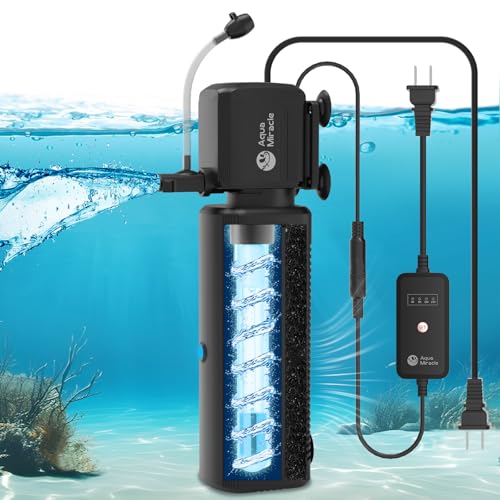
Model SV-1000 fits 60–150 gallon tanks and includes a built-in timer. It emphasizes improved water clarity through UV treatment and enhanced oxygenation and circulation. Best for hobbyists who want scheduled UV exposure without manual reset. Caution: timer features are for the light, not the pump, so plan maintenance accordingly.
Buying Guide
What should you consider when choosing a UV sterilizer for a 125-gallon tank?
- Tank size and flow rate: Larger tanks benefit from higher GPH filters or multi-stage filtration to ensure water passes through the UV chamber efficiently.
- UV lamp power and wavelength: Most units use 254 nm UV-C; higher wattage generally supports larger volumes if flow is controlled.
- Filtration integration: Do you want a standalone UV sterilizer or a canister/inline system that also filters and circulates water?
- Maintenance access: Look for easy lamp replacement, cleanable sleeves, and accessible filter media for minimal downtime.
- Noise and space: Submersible units can produce audible hum if not fully submerged; ensure adequate cabinet space for placement.
Practical Comparison Questions
- Is UV light effective in saltwater and freshwater tanks alike? Yes, UV-C sterilizers are used for both, but flow and exposure time matter.
- Should I run UV continuously or on a timer? Timers help balance lighting needs with energy use and maintenance schedules.
- Can a UV sterilizer replace my mechanical filtration? No, UV enhances water clarity but does not remove particulates as a filter does.
- What’s a sign I need a larger UV unit? Cloudy or green water that persists after standard filtration may indicate a larger UV exposure or longer contact time is needed.
- Do all units require a separate pump? Some models include a pump; others rely on your existing tank pump for circulation.
FAQ
Q: Can UV sterilizers harm fish or plants? A: When installed and operated correctly, UV-C exposure is isolated to water passing through the unit and does not come into direct contact with fish or plants. Always follow manufacturer guidance on flow rates and maintenance.
Q: How often should I replace UV lamps? A: Lamps typically require replacement after about 9–12 months of continuous use, depending on model and water quality.
Q: Will UV sterilizers reduce beneficial bacteria? A: UV exposure targets free-floating microorganisms; it does not significantly disrupt beneficial biofilms on filter media when used as directed.
Q: Can I run multiple UV devices in one system? A: It’s possible but should be done with consideration of flow and tank turnover to avoid dead spots or unnecessary UV exposure.